If you ever took a cheesecake out from your oven and saw a big crack right in the middle, you already know the big frustration. The sous vide cheesecake completely solves this trouble. By cooking your batter inside a water bath that is controlled exactly at 176°F (80°C), the egg proteins become set very slowly and evenly from the edges to the center. This gives you a texture that is silky and ultra-creamy, which a normal oven just cannot copy. This is not only a trendy way of cooking. Truly, it is the most dependable way to make a cheesecake without flaws. Once you understand the way it works, you will never use the traditional method again.
Why the Water Bath Changes Everything
A standard oven bakes things with dry heat that goes up and down. Even if you put a pan with water on the rack below, the edges of your cheesecake still finish cooking faster than the center part. That uneven cooking is the thing that causes the cracking, too much browning, and that grainy texture you sometimes find near the outside edge.
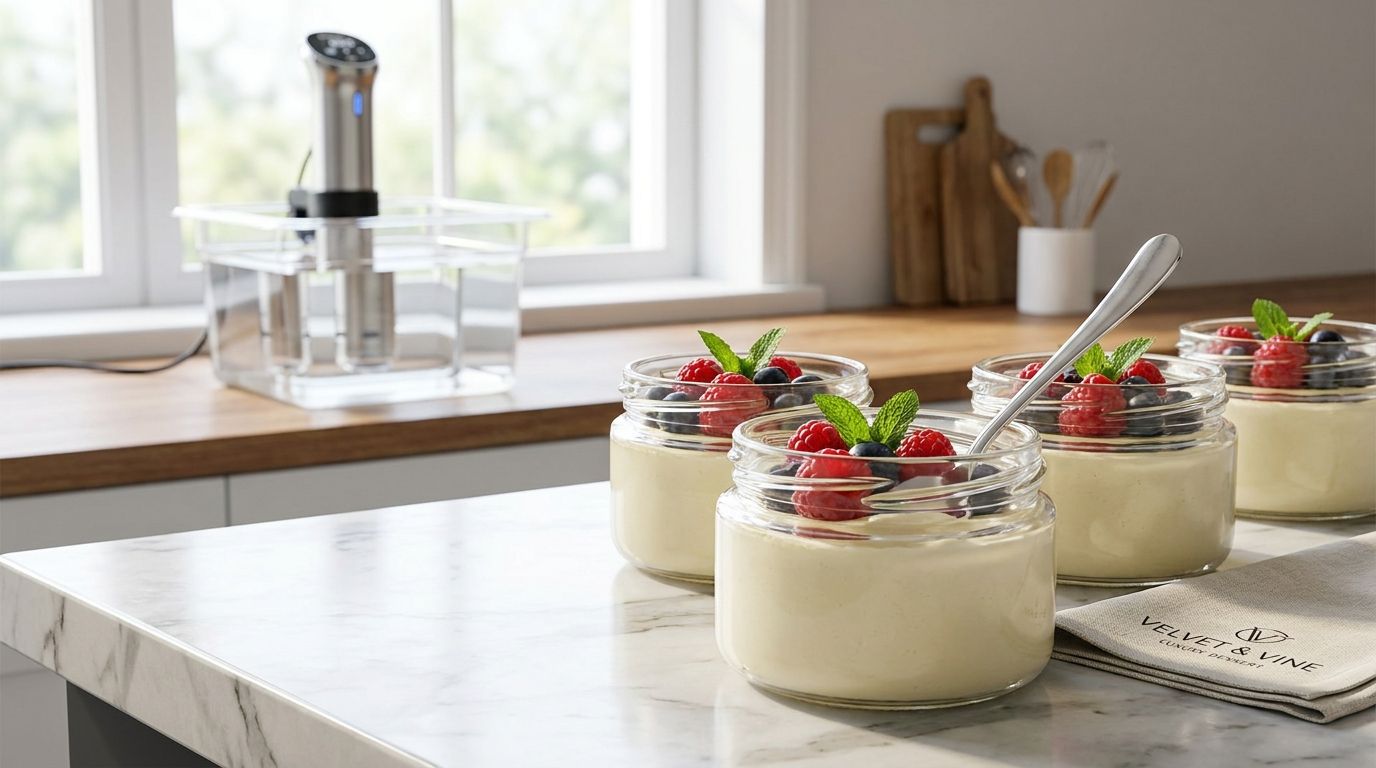
Sous vide takes away all of this uncertainty. The water goes around the jar or the pan on every side with a temperature that stays perfectly stable. There are no hot areas, no drafts of air, and no guessing. The batter cooks at the exact same speed everywhere. Also, because the temperature never goes above 176°F, the proteins never become tight or like rubber. The result you get is a dense, creamy set that tastes much richer than anything you bake inside an oven.
How the Filling Sets at This Temperature
When you understand the science, it makes you a better cook. Eggs are the ingredient that gives the structure to the cheesecake, and egg proteins start to coagulate around 145°F to 158°F. At 176°F, these proteins reach a set that is firm but still soft. They do not get tight or squeeze out the moisture, which is exactly what happens when you overbake a cheesecake at 325°F or 350°F.
The fat inside the cream cheese also acts differently when the temperature is lower. It stays mixed in completely instead of separating, and this is what makes that glossy, dense texture. The sour cream or the Greek yogurt in the filling gives just enough acid so the proteins do not bond together too strongly. This keeps the final texture on the softer side, even after you chill it.
The Graham Cracker Crust: To Pre-Bake or Not?
Most recipes for sous vide cheesecake do not pre-bake the crust because the water bath does not get hot enough to toast your cracker crumbs. If you only mix the crumbs with melted butter and press them down into the jar, you will get a base that is soft, dense, and a bit wet after the cooking is done. It is not terrible, but it does not have that contrast of textures.
To get a result that is noticeably better, press the crumb mix into each jar and bake them without any lids at 350°F for about 10 minutes before you put the filling inside. This makes the crust crispy, makes the flavor a bit deeper, and gives that nice snap when you put your spoon in. You must let the jars cool down completely before spooning the filling inside. If you do not, the heat will start to cook the batter unevenly before the jars even enter the water bath.
The Rule of the “Fingertip-Tight” Lid
This is the specific detail where people make the most mistakes, and you need to pay close attention to it. When you turn the lids onto your mason jars, they must be only fingertip tight. This means you turn the metal band using just your fingertips until you feel the very first bit of resistance, and then you stop.
If you tighten the lids completely, the air and steam cannot get out when the batter gets hot and expands inside the jar. That trapped pressure can break the glass. When the lids are just fingertip tight, you will see small lines of tiny air bubbles coming up from the edges of the jar while cooking. This shows you that the seal is correct and the steam is escaping safely. Once the jars come out and start cooling, the lids will seal by themselves as the pressure becomes equal.
Chilling and Finishing Your Cheesecake
After spending 90 minutes inside the water bath, the cheesecakes will look firm around the edges but they will still wobble a little bit in the center. This is normal and it is correct. Move the jars into an ice bath for about 30 minutes so the cooking stops quickly, then put them in the refrigerator for at least four hours—though keeping them overnight is better. The texture becomes much firmer as it gets cold, and the flavor develops a lot more after a whole night of resting.
When it is time to serve, you can run a thin spatula around the edge if you want to turn them upside down onto a plate, or you can serve them directly inside the jar with any topping you like. Fresh berries, a simple berry sauce, or a thin layer of lemon curd all go very well. The clean, neutral taste of the cheesecake base matches with almost anything that is acidic or fruity.
Making a Bigger Batch for a Crowd
One true benefit of the sous vide cheesecake is how easily you can change the recipe size. A single batch of filling usually fills up six to eight jars of 4-ounce size. If you are cooking for a bigger group of people, you can double the filling and put more jars into the water bath. The cooking time stays exactly the same no matter how many jars are inside the water, as long as they stay fully under the water and the temperature stays steady. This makes it a very practical choice for parties or for meal prep, because the separate jars also stay nicely in the fridge for up to five days.
Common Problems and What Causes Them
-
Spongy or foamy texture: This almost always happens because you mixed the batter too much, especially after putting the eggs in. Once your eggs are inside, mix only until the batter combines and looks smooth. Too much mixing traps air, and that air grows bigger in the water bath, giving the cheesecake a holy, porous structure instead of a dense, creamy one. Tapping the bowl hard on the counter a few times after mixing helps to release the air bubbles before you put the filling into jars.
-
The center looks like liquid after 90 minutes: Check if your immersion circulator is truly holding 176°F and make sure the jars are completely under the water. A jar that is partly sticking out will cook unevenly. You can easily add another 10 or 15 minutes of cooking without any danger of overcooking at this temperature. This is another big advantage this method has over regular oven baking.
The sous vide cheesecake is not just a trick for professional chefs or something special for people who own expensive kitchen tools. It is truly a better method that gives a better result every time with much less stress than normal baking. Once those jars go into the water bath, you do not need to think about them again for the next 90 minutes.