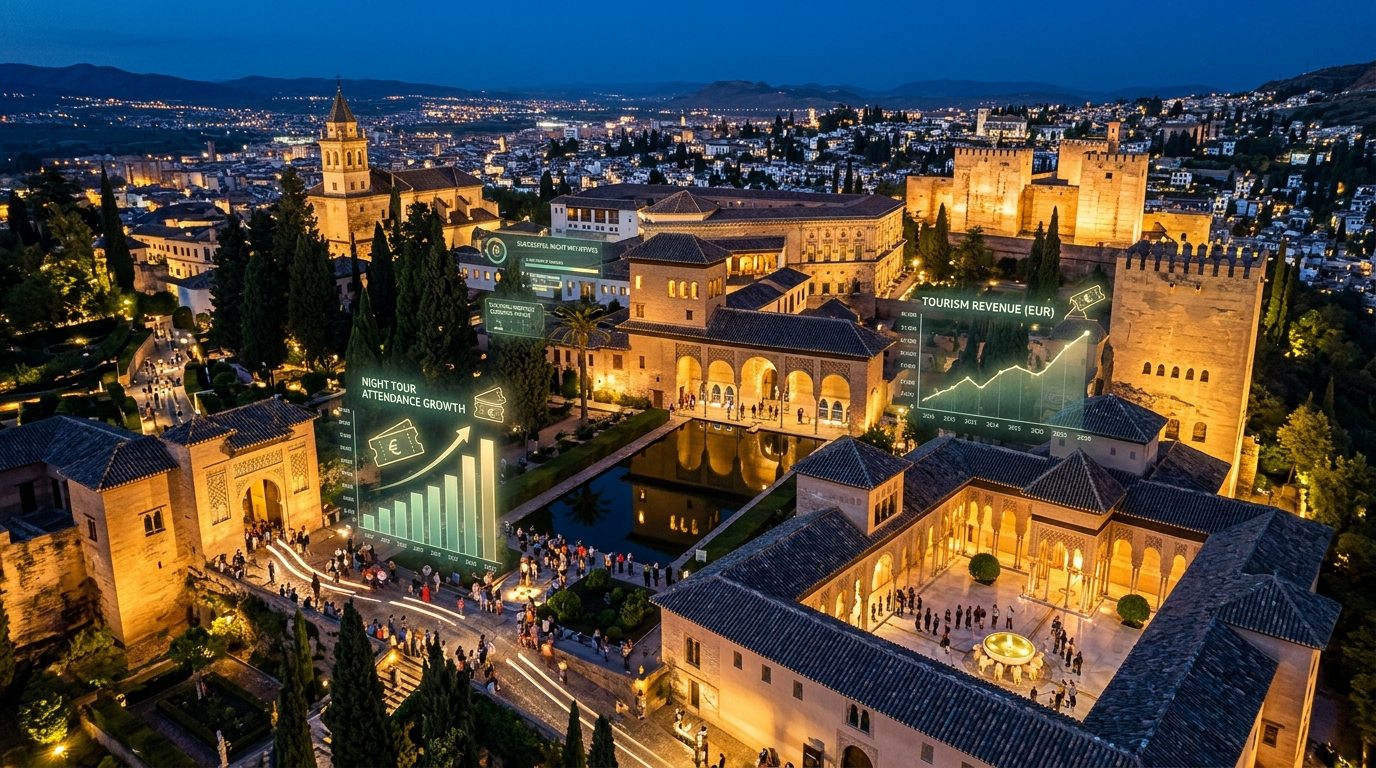
For people who search for Alhambra Palace night tour attendance revenue, mainly two questions are in mind: how many visitors are actually allowed inside the palace once darkness falls, and how much money this restricted access brings for the site. In simple words, night visits are kept much lower in number than the daytime ones on purpose, and the money side comes not from one fixed ticket price but from a combination of cheaper self-guided tickets along with costlier guided packages. Since the Alhambra already receives millions of tourists year after year, if even a small portion of them shift towards evening timing, it becomes a steady and worthwhile income source, and at the same time it saves the monument from the damage that daily heavy footfall usually brings.
Why Night Visits Exist at All
The idea behind night tours was never to take the place of daytime visits. Instead, they work more like a safety valve for one of Spain’s most visited heritage locations. Every year, daytime footfall goes into millions, and such heavy movement of people creates real pressure on stonework, tiles, and plaster that is centuries old. By moving part of the visitor demand to evening hours, congestion inside the Nasrid Palaces during the day becomes lighter, and tourists also get a more peaceful, less crowded way of viewing the same halls. With fewer people present in a shorter time frame, preservation conditions also improve, because things like lighting, humidity, and human movement can be managed with much more control at night compared to a full day of open access.
How Night Tour Attendance Is Structured
On purpose, night attendance is kept much smaller than what is allowed during the day. Rather than free-flow entry, visitors are required to book a fixed time slot, and the total number of these slots is decided beforehand. This works quite differently from daytime tickets, where a much larger number of people can move through the site across many hours. During night hours, generally only one part stays open at a time, either the Nasrid Palaces or the Generalife Gardens, never both at once, and this further reduces how many people are present on any single night.
The way schedules are arranged also has a big effect on attendance numbers. In summer, evening slots usually run somewhere between 10 pm and 11:30 pm, from Tuesday to Saturday, so there are more nights available across the week for visitors. In winter, this gets reduced quite a bit, with entry mostly allowed only on Friday and Saturday, between 8 pm and 9:30 pm. Because of fewer nights and shorter seasonal windows, winter attendance naturally stays lower than the busier summer season, and this is something worth keeping in mind for anyone trying to work out yearly totals instead of just numbers for a single evening.
Ticket Pricing and How It Shapes Revenue
The money earned from night visits does not come from one flat charge but from several layers of pricing. Self-guided night entry is usually the cheapest choice, with basic access to the Generalife Gardens costing less than entry into the Nasrid Palaces, since the interior of the palace is treated as the more premium part of the experience. Discounted rates are normally available for younger visitors and students, while children below a certain age can usually enter for free, and this slightly pulls down the average income per person while making the experience open to more people.
Guided night tours, on the other hand, come at a clearly higher cost. Along with entry, these packages include a trained guide who walks visitors through the Nasrid Palaces while explaining the history, architecture, and meaning behind the detailed plasterwork and courtyards. Since knowledge and access are being offered together, the price naturally goes up compared to a plain self-guided ticket. Private night tours sit right at the top of this pricing ladder, offering smaller groups, more flexible timing, and a personal pace, all of which justify a premium price when set against self-guided or standard group tours.
Once all these pricing levels are put together, the overall revenue pattern becomes easier to understand. Most visitors go for the lower-cost self-guided option, and this keeps night tourism within reach for a wide range of travelers. A smaller group, however, chooses guided or private experiences, and even though this group is smaller in number, it ends up contributing a much bigger share of total revenue because of the higher price attached to each ticket. This kind of layered pricing model is fairly common across major heritage sites around the world, where affordable general entry runs side by side with premium guided options, in order to serve different visitor budgets while still maximizing total income.
What Drives Demand for Evening Visits
A number of factors keep pushing demand towards the night option. Cooler weather during summer evenings makes walking through gardens and palace corridors much more pleasant compared to the strong midday heat common across southern Spain. Lighting design also plays a strong part, since the palace is lit in a way that brings out architectural detail that often goes unnoticed under bright daylight, giving the same spaces a completely different mood after dark. Smaller crowds add to the appeal too, as visitors get more room to properly look at detailed ceiling work, courtyards, and reflecting pools without having to move through large daytime groups.
Limited availability itself becomes another reason demand stays high. Since night slots are capped and offered only on certain days depending on the season, tickets often sell out well ahead of time during peak travel months. This kind of scarcity naturally creates more urgency to book early, and that keeps ticket sales steady even though the total count of night visitors remains far smaller than daytime numbers.
The Bigger Picture
Taking a broader look at Alhambra Palace night tour attendance revenue, the overall pattern makes sense even without one official combined figure being available. Attendance stays deliberately low compared to daytime visits so that the site can be protected and the visitor experience can be improved, while revenue comes through a layered pricing setup that mixes affordable self-guided access with pricier guided and private choices. Seasonal scheduling shapes both numbers further, with summer allowing more nights of access and winter cutting things back quite a bit. Taken together, these factors explain why night tours remain a small yet valuable part of how one of Spain’s most visited landmarks manages both preservation and visitor demand.