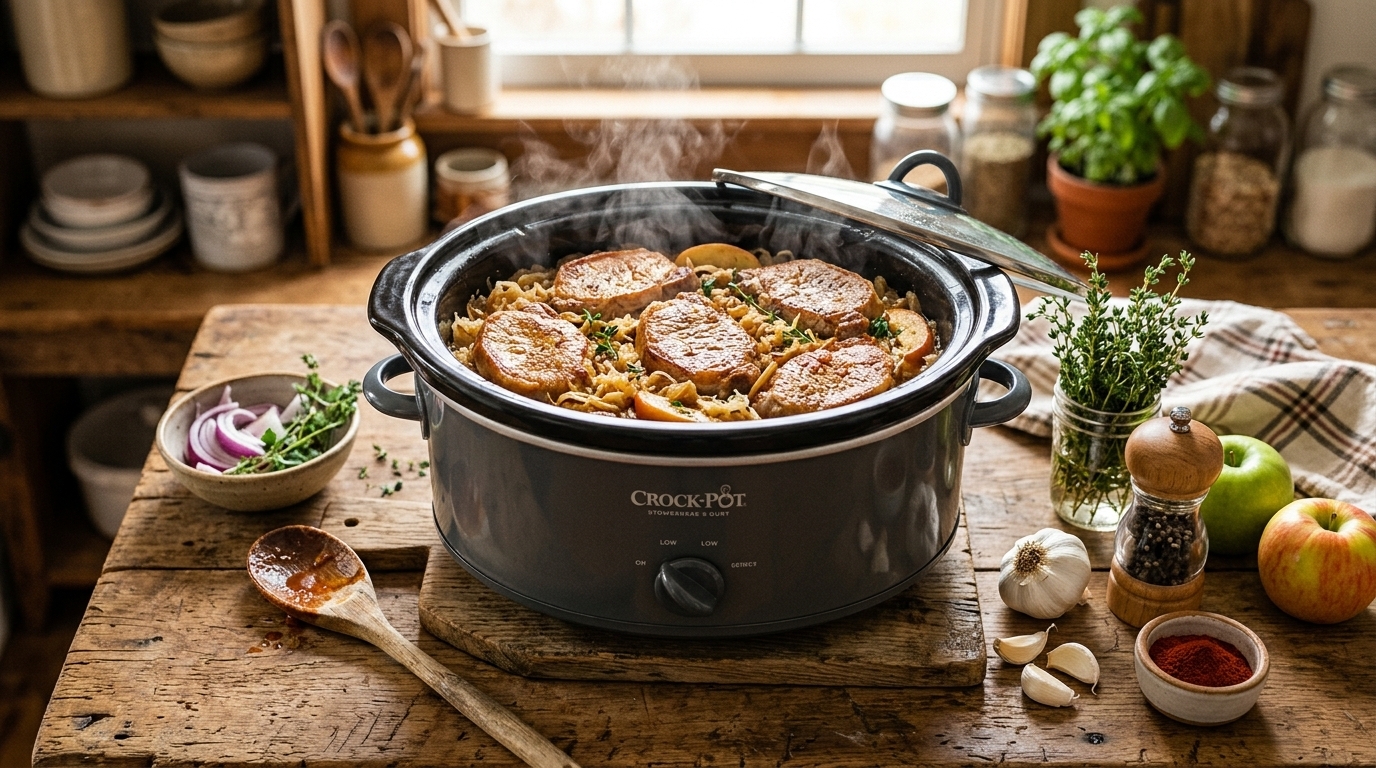
Anyone who is searching for a recipe for pork chops and sauerkraut in slow cooker, this is what you do: first the chops you season, then into the pot everything goes together, the sauerkraut, apple slices, onion, and a little brown sugar, and on low heat for five to six hours it all slowly cooks. That is really all. When you come back, pork that falls apart is waiting for you, and a sauce that tastes like someone actually tried hard to make it. On AllRecipes a two-ingredient version exists that many people are loving, but honestly with few more ingredients the final flavor becomes something much more worth eating.
Why These Two Ingredients Have Always Gone Together
Pork with sauerkraut is not some trendy combination that somebody recently invented. Already centuries ago in German and Eastern European kitchens this was very normal, because through the winter months, fermenting cabbage was one of the only real ways to keep vegetables from spoiling. Pork was the protein that most families could actually afford to buy. Out of practicality these two ended up together in the same pot, but slowly cooks began to understand that they also taste genuinely good as a pair. The acid inside the kraut works on the pork slowly and breaks it down, and from the meat the fat softens whatever sourness the cabbage is carrying. When in a slow cooker they cook together for long hours, that exchange of flavors goes even deeper than usual. Once someone tastes it, the combination makes complete sense.
What the Apple and Brown Sugar Actually Do
Many basic recipes are not including apple at all. That is not a wrong choice exactly, but when one is added the dish changes in a noticeable way. A Granny Smith apple, because it is already quite tart, does not push the flavor anywhere sweet. It only adds a light fruity background note that lifts everything else sitting in the pot. Over such a long cook it dissolves almost completely, so when finally you lift the lid you will not even find it anymore. Brown sugar is working in a very similar way. Nothing sweet is being made here. Only one third of a cup is going in, and that small amount is just enough so the sharp edge of the fermented cabbage softens and goes away, without tipping the whole flavor somewhere wrong. Together what they give to the cooking liquid is more depth and more dimension.
Bone-In vs Boneless in a Slow Cooker
Inside a slow cooker, bone-in chops are genuinely holding up much better. The bone itself is slowing moisture loss during the long cook, and something extra it is adding to the liquid that boneless chops simply are not able to give. If boneless is what you have available right now, go ahead and use them, but the timing must be watched carefully. At five hours on low heat, take them out and check the internal temperature. Once pork goes past 145 degrees Fahrenheit it begins drying out very fast, and after that happens no amount of sauerkraut juice is going to fix it.
Never Drain the Sauerkraut
This is a step that gets ignored more often than it really should. The liquid sitting inside that bag or jar of sauerkraut is actually your cooking liquid for this dish. Over the many hours of heat it is keeping the pork from drying out, and the fermented flavor that the whole dish depends on is being carried entirely by it. If you pour it out, both of those things are lost together. Some people are rinsing their sauerkraut because on its own they find it too sour to enjoy, but after six hours inside a pot together with apple, onion, and brown sugar, that sourness quietly settles into the background. That is exactly where you are wanting it to be.
The Full Recipe
Serves 4.
What you are needing: 4 thick-cut pork chops, 2 pounds of sauerkraut left undrained, 1 large Granny Smith apple sliced thin, 1 medium yellow onion also sliced thin, 1/3 cup of brown sugar, 1 tablespoon olive oil, 1 teaspoon garlic powder, 1 teaspoon kosher salt, 1/2 teaspoon black pepper, and if you are having them available, 1/2 teaspoon caraway seeds.
First with a paper towel you dry the chops off completely. Then the salt, pepper, and garlic powder you rub into both sides well. A skillet you get hot with the olive oil, and into it the chops go for two to three minutes on each side. Only a crust is what you are building at this stage, not cooking them through fully. After that you set them aside.
In a bowl you mix together the sauerkraut, apple, onion, brown sugar, and the caraway seeds. Half of this mixture goes into the bottom of a 6-quart slow cooker first. Then on top of that you lay the chops down flat. With the remaining sauerkraut mixture you cover them fully. The lid goes on. On low heat 5 to 6 hours it cooks, or if you prefer on high heat 3 to 4 hours is enough. When inside the pork the temperature reaches 145 degrees and without any resistance it is breaking apart, that is when you pull them out.
Sides That Make Sense With This
Mashed potatoes are the most obvious choice here and with very good reason they are. The liquid collecting at the bottom of the slow cooker is working essentially as a ready-made sauce, and into mashed potatoes it is soaking in perfectly. Egg noodles are working in exactly the same way. If something lighter is what you want on the side, roasted carrots or a simple green salad are both good options because they cut through the richness without competing against the main dish at all.
Leftovers and Storage
The next day, if you are being honest, this dish is actually tasting better than it did fresh. Overnight the flavors are settling together in a way that makes the leftovers feel more developed than even the first serving was. In a sealed container inside the fridge, for up to four days they are keeping well. When you are reheating, a small splash of water or broth you should add so the pork is staying moist. For anyone making a bigger batch ahead of time, in the freezer for up to three months it is keeping without any problem at all. This recipe for pork chops and sauerkraut in a slow cooker is genuinely one of those meals where from the very beginning, doubling the whole batch is completely worth doing.