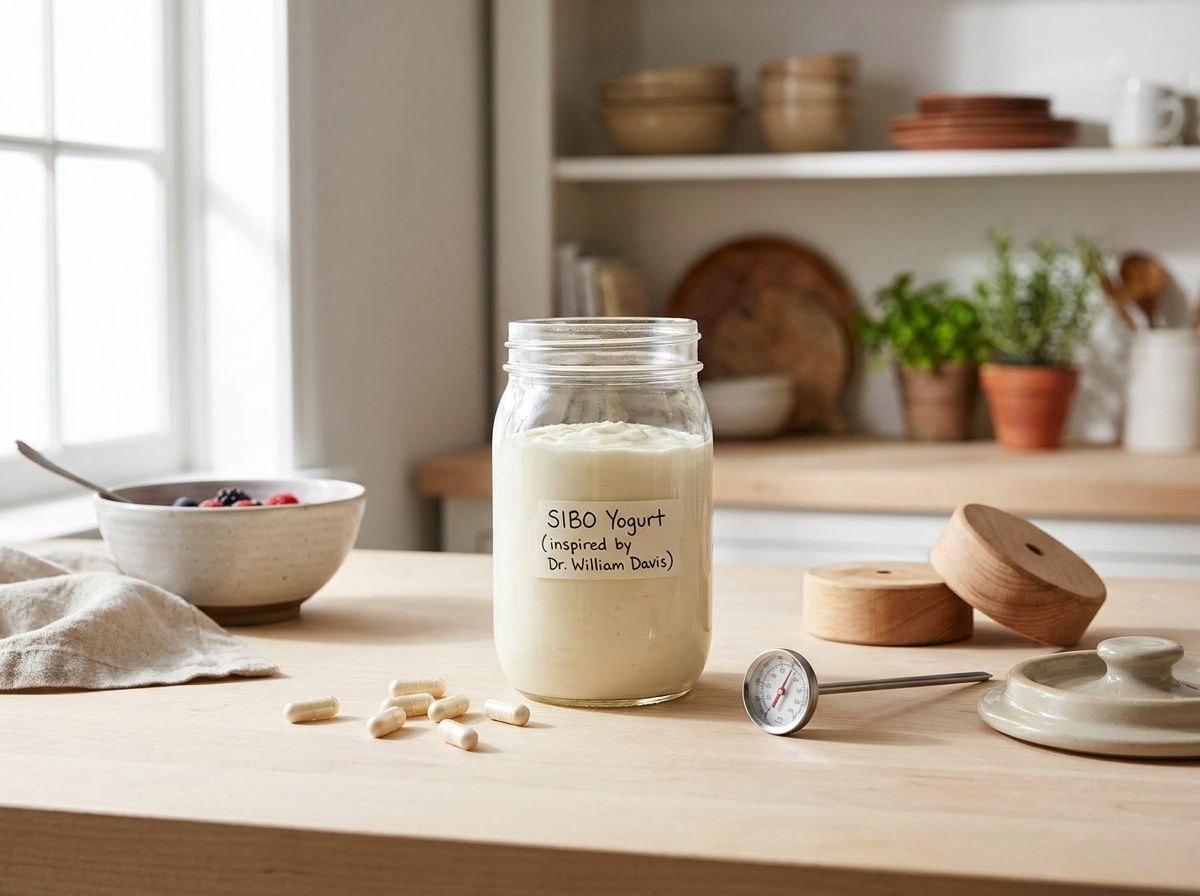
Look, if your stomach has been a mess for a while, you’ve probably gone down a lot of rabbit holes trying to figure out what’s going on. I get it. And somewhere along the way you probably landed on this yogurt. The one Dr. William Davis keeps talking about. The one that ferments for 36 hours and uses probiotic tablets instead of store bought starter culture. Yeah, that one.
Here’s what it actually is and how to make it without messing it up.
First, What Even Is SIBO
SIBO is short for Small Intestinal Bacterial Overgrowth. What that means in plain terms is that bacteria which are supposed to stay in your large intestine end up moving into your small intestine. And your body really doesn’t like that. The result is all that stuff nobody wants to talk about. Bloating after meals. Gas. Inconsistent digestion. Brain fog. Sometimes constipation, sometimes the opposite. It’s miserable and a lot of people walk around with it for years without knowing what’s actually causing their symptoms.
Dr. Davis, who’s a cardiologist and has written extensively about gut health, started looking at specific probiotic strains and what they actually do inside the body. His conclusion was that the yogurt most people eat does almost nothing meaningful for gut bacteria because the bacterial counts are too low and the strains are wrong. So he built a recipe around strains that have actual research behind them and a fermentation process that produces bacterial counts high enough to make a real difference.
The Strains and Why They Matter
This is the part most recipe sites gloss over but it’s honestly the most important piece to understand.
The main strain is Lactobacillus reuteri. You get it from BioGaia ProTectis tablets, and you need 10 of them per batch. That’s not a typo. Ten. This strain has two sub-strains inside it, DSM 17938 and ATCC PTA 6475, and both have been studied for things like fighting harmful gut bacteria, supporting immune health, and interestingly, influencing mood and sleep through the gut-brain connection. A lot of people who make this yogurt consistently say they notice differences in how they feel overall, not just digestively.
Then there’s Lactobacillus gasseri, specifically BNR17. Two capsules per batch. This one works on digestive comfort and has been studied in relation to abdominal issues and metabolic health. And Bacillus coagulans, GBI-30,6086, also two capsules. It’s a spore-forming bacteria which basically means it’s built to survive conditions that would kill off weaker strains. It helps with regularity and reducing gut inflammation.
Three strains. Each doing something different. Together they work on the gut in a way no single probiotic supplement really can.
What You’re Going to Need
One quart of organic half-and-half. That’s your base. Then the 10 BioGaia ProTectis tablets, 2 capsules of Lactobacillus gasseri, and 2 capsules of Bacillus coagulans. Plus 2 tablespoons of inulin or raw potato starch as your prebiotic fiber. The prebiotic is what the bacteria eat during fermentation. Without it the bacterial growth is much lower and you’re basically wasting your time and ingredients.
How to Make It
Crush the BioGaia tablets. Empty the other capsules. Mix all those powders together in a bowl with the 2 tablespoons of prebiotic fiber. Add just a tiny bit of half-and-half and stir it until everything becomes a smooth paste. Then slowly pour in the rest of the half-and-half while stirring.
Pour it all into a glass jar and set it to ferment at 100 to 106 degrees Fahrenheit. Leave it alone for 36 hours. This is where people get impatient and pull it early. Don’t. The whole point of 36 hours is giving the bacteria enough reproduction cycles to reach the counts that actually make this yogurt useful. Pulling it at 24 hours gives you a weaker product.
After 36 hours, put it in the fridge for at least 6 hours before eating. It needs that time to firm up.
It’s Going to Look Weird and That’s Fine
Watery liquid pooling at the top or bottom of the jar. Softer or looser texture than regular yogurt. A pretty sour taste. All of that is normal and expected. The whey separation especially throws people off the first time. Nothing is wrong. Just stir it back in or pour it off depending on what texture you want.
Making Your Next Batch
Save 2 tablespoons from your finished yogurt and use it as the starter for your next batch instead of buying new capsules. Mix it with fresh half-and-half and prebiotic fiber, ferment for another 36 hours, done. You can keep doing this for several batches before starting fresh.
Start with a small amount when you first try it, around a quarter cup a day. Some people feel some digestive shifts in the first week as their gut adjusts. That usually settles down pretty quickly. The Dr William Davis SIBO yogurt recipe isn’t complicated once you’ve done it once, and most people find it becomes part of their routine without much effort.