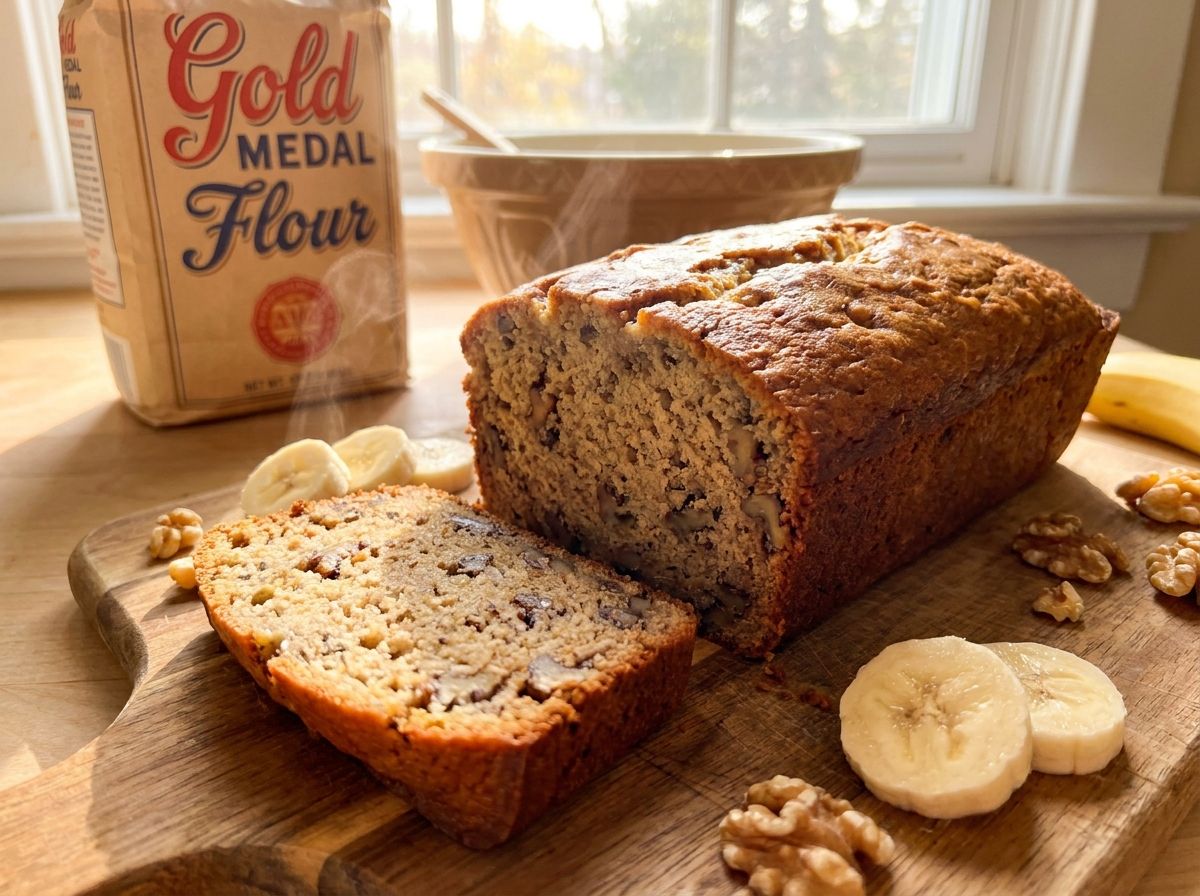
So I had four bananas sitting on my counter last week that were basically black. Not just spotty. Black. Most people would throw them out and honestly I almost did. But those are actually the best bananas you can use for this recipe and once you know that it changes everything about how you think about overripe fruit.
The Gold Medal Flour banana bread recipe is the one I keep coming back to. It’s old, it’s simple, and it works in a way that fancier recipes sometimes don’t. One bowl, basic ingredients, no mixer required if you don’t want to use one. The bread comes out moist and dense in a good way, not heavy, just substantial. It tastes like banana bread should taste.
The Buttermilk Thing
Before anything else I want to talk about the buttermilk because this is where people either trust the recipe or they don’t.
A lot of people don’t keep buttermilk at home and when they see it in an ingredient list they just swap it for regular milk or skip it entirely. Please don’t do that here. Buttermilk has a mild acidity to it and that acidity does two things. It activates the baking soda so the bread actually rises the way it should, and it keeps the crumb soft and a little tender rather than dry. Regular milk won’t do the same thing.
If you genuinely don’t have it, pour about half a tablespoon of lemon juice into a cup and fill the rest with whole milk to the half cup line. Give it a stir and wait five minutes. It curdles a little and looks weird but that’s what you want. Use that.
Ingredients
This makes one large loaf in a 9 x 5 inch pan or two smaller ones if you use 8.5 x 4.5 inch pans. I usually go with the two smaller loaves because one goes in the freezer and the other gets eaten within two days at my house.
- 1 and 1/4 cups granulated sugar
- 1/2 cup butter, softened at room temperature
- 2 large eggs
- 1 and 1/2 cups mashed ripe bananas, roughly 3 to 4 medium bananas
- 1/2 cup buttermilk
- 1 teaspoon vanilla extract
- 2 and 1/2 cups Gold Medal all-purpose flour
- 1 teaspoon baking soda
- 1 teaspoon salt
- 1 cup chopped nuts if you like them, I usually skip these
Now about those bananas again. They need to be soft and brown. Yellow bananas with a couple of spots are not ripe enough for this. The flavor of the bread depends almost entirely on how much sugar has developed in the fruit and that only happens when they’re properly overripe. If yours aren’t there yet, put them whole and unpeeled on a baking sheet and slide them into a 300 degree oven for 20 minutes. The skins go completely black which looks like you’ve ruined them but the inside gets soft and sweet and works perfectly. I’ve done this more times than I can count.
Putting It Together
First thing, move your oven rack to a low position. Not the very bottom but one step above it. This helps the heat reach the bread from underneath and prevents the top from browning too fast before the center has time to cook through.
Preheat to 350 degrees F.
Grease only the bottom of your pan. Not the sides. I know it feels wrong but the batter needs to grip the sides as it rises. If the sides are greased the batter slides and you lose height. Just the bottom.
In a large bowl mix the sugar and softened butter together. Add both eggs and stir until it looks smooth. Pour in the mashed bananas, buttermilk, and vanilla. Stir it all together until the batter is mostly smooth. It doesn’t have to be perfect.
Here’s the part that matters most. Add the flour, baking soda, and salt. Stir until you can’t see dry flour anymore. Then stop. Seriously, stop. The batter will look a little lumpy and that’s completely fine. Every extra stir after the flour is incorporated builds more gluten and gluten is not your friend in banana bread. It makes the finished loaf tough and chewy instead of soft. If you’re adding nuts fold them in now with just a couple of turns.
Pour the batter into your pan. Put it in the oven.
For a 9 inch loaf give it about an hour and 15 minutes. For two 8 inch loaves check around the one hour mark. Stick a toothpick straight into the center and if it pulls out clean with nothing wet on it the bread is done. If there’s wet batter on it give it another 10 minutes and check again.
When it comes out let it sit in the pan for 10 minutes. Then run a knife around the edges and turn it out onto a wire rack. Now leave it alone for two full hours before cutting into it. The inside is still finishing up as it cools and if you cut it too early the center will be sticky and gummy. Wait it out. It’s worth it.
Storing It
Once it’s fully cooled wrap it tight. Plastic wrap or an airtight container both work. It keeps at room temperature for about four days. If you put it in the fridge it lasts up to 10 days but it gets a little firmer when it’s cold so give a slice a minute or two at room temperature before eating or just microwave it for 30 seconds.
The freezer is honestly the best option if you’re not going to eat it all quickly. Slice the whole loaf before freezing, wrap each slice individually, and put them in a zip bag. They keep for three months easy. You can pull out a single slice whenever you want and microwave it from frozen in about 45 seconds. It tastes almost exactly the same.
FAQs
The middle of my loaf sank after baking. Why?
Ripe bananas bring a lot of moisture to the batter and the center takes longer to cook through than the edges do. The outside can look fully done and smell amazing while the middle is still wet. This is really common. The toothpick test is the only reliable way to check. Also, don’t open the oven door in the first 45 minutes. The temperature drops when you do that and an underbaked center can collapse before it gets a chance to set properly.
Can I use a different flour?
Whole wheat flour works as a partial substitute. Swap out up to half the all-purpose flour and the texture stays fairly similar, maybe a touch heartier. Replace all of it and the loaf gets dense and earthy, which some people genuinely love. Gold Medal actually has a separate whole wheat banana bread recipe if you want something specifically built around that flour rather than just a substitution.
Can I add stuff to it?
Yes, fold in about 3/4 of a cup of whatever you like, chocolate chips, blueberries, walnuts, even a swirl of peanut butter. Do it at the very end after the flour is mixed in, same as the nuts. The bake time stays the same, just use the toothpick to check.
Does it really matter which flour brand I use?
For a recipe that specifically calls for Gold Medal I’d stick with it, at least the first time. Different flours have slightly different protein levels and moisture absorption rates. Gold Medal all-purpose sits at around 10 to 11 percent protein which is right for this kind of bread. Once you’ve made it once and know what the batter should look and feel like, you can experiment more.