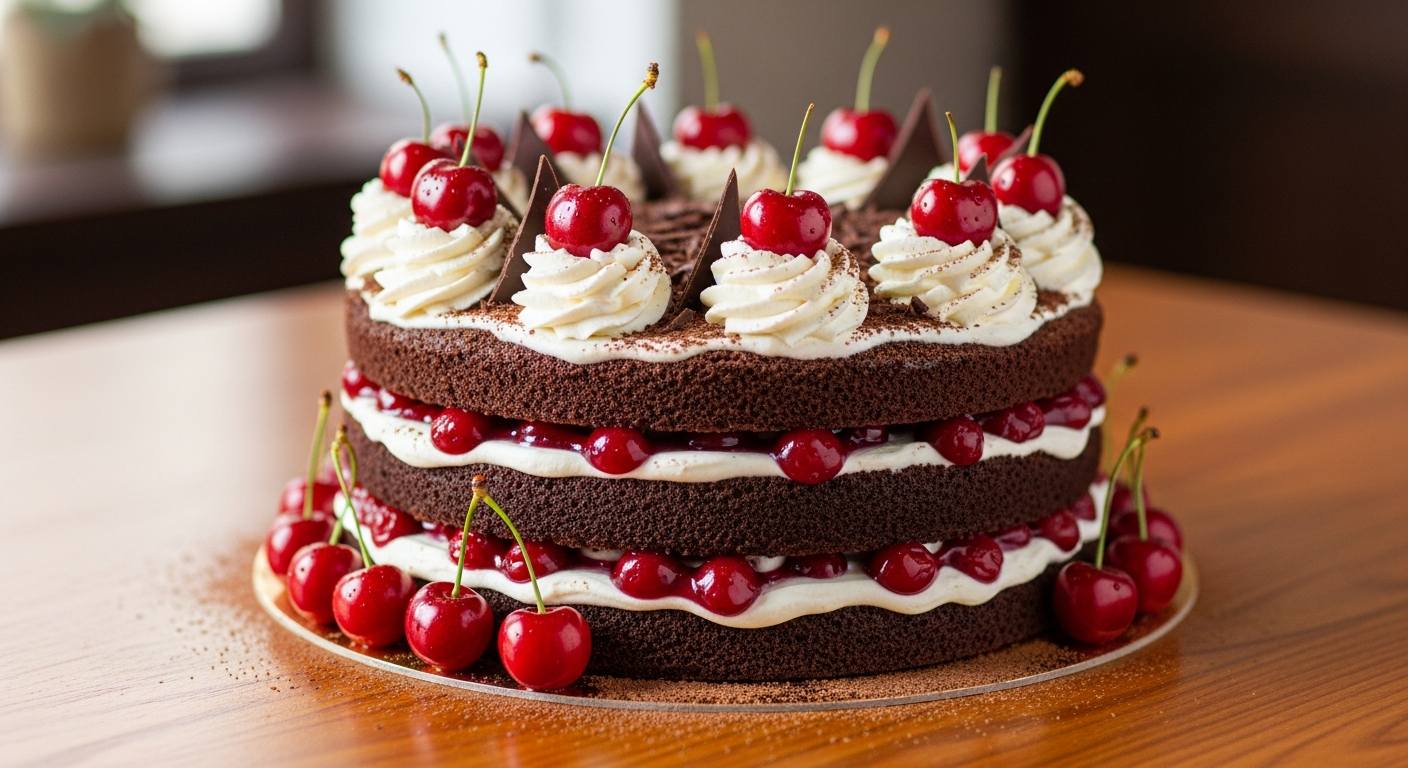
If you’ve ever savored a slice of Black Forest cake, you might wonder where this rich chocolate and cherry dessert comes from. In fact, the Black Forest cake (or Schwarzwälder Kirschtorte in German) originated in southwestern Germany’s Black Forest region about a century ago. It combines layers of chocolate sponge, whipped cream, cherries, and a splash of cherry brandy (Kirschwasser). The cake likely took shape in the early 1900s, inspired by local ingredients like sour cherries and kirsch. Since then, it has become a beloved classic worldwide, but its exact creator remains a tasty mystery.
The cake’s history is as layered as its flavors. It draws on long-standing German baking traditions but really crystallized as its own dessert in the 20th century. Here’s a closer look at how this iconic cake evolved, blending legend and fact, regional pride and international fame.
A Taste of the Black Forest
The Black Forest region (Schwarzwald) in southern Germany is famous for dense pine woods, picturesque villages, cherry orchards, and a clear cherry schnapps called Kirschwasser. All these local features shaped the cake. In fact, Schwarzwälder Kirschtorte literally means “Black Forest cherry torte.”
-
Local Flavors: The cake’s key ingredients – cherries and cherry brandy – come from this area. Farmers here have long preserved sour cherries and made Kirschwasser from them. Pastry chefs started soaking chocolate sponge layers with Kirsch to add a warm, fruity kick.
-
Name Inspiration: The cake’s look also plays a part. Its dark chocolate layers, white whipped cream, and bright red cherries match the colors of traditional Black Forest costumes. Some say the cake even mimics the famous Bollenhut, a local women’s hat decorated with big red pom-poms. Whether inspired by drink, dessert, or design, the cake’s name celebrates the Black Forest’s heritage.
Because of these ties, Kirschwasser is considered essential in a true Black Forest cake. In fact, a European Union rule (made official in 2013) says that for a cake to be called Schwarzwälder Kirschtorte in the EU, it must contain locally-made Black Forest cherry brandy. This shows just how closely the dessert is guarded as part of regional culture.
Who “Invented” It?
Nobody knows for sure who first baked the modern Black Forest cake, and experts debate its origins. The idea of combining cherries, cream, and chocolate has roots in old German desserts. For example, in the 1800s, some recipes paired cherries with cream. But the cake as we know it – a layer cake drenched in Kirsch – started appearing about 100 years ago. Several stories point to early 20th-century bakers in Germany:
-
Josef Keller (1915): A German pastry chef named Josef Keller claimed he made the first version in 1915 at his Bad Godesberg bakery. According to stories, Keller layered chocolate cake with cherries, whipped cream, and cherry brandy. He later moved and kept serving the cake in Radolfzell (on the lake).
-
Erwin Hildenbrand (1930): Another German baker, Erwin Hildenbrand of Tübingen, is also credited by some sources. In 1930, he reportedly served a similar cherry-chocolate cake at his café.
-
Triberger Tradition: The town of Triberg, deep in the Black Forest, has its own claim. Café Schäfer there even says it holds an “original” recipe and calls itself the cake’s birthplace.
The truth might be that the cake evolved gradually. Bakers used local cherries, cream, Kirsch, and chocolate in different ways. No single cookbook or inventor started it all.
Key Milestones in Black Forest Cake History
-
1915: The name Schwarzwälder Kirschtorte shows up (around this year) in records. Josef Keller later claimed he was already making it then.
-
1927: A recipe for the cake was kept in Radolfzell archives, making it one of the first documented versions.
-
1934: The term Black Forest cake appears in a German pastry cookbook. (Some sources say 1934 was the year the dessert was first published in writing.)
-
1951: Dr. Oetker, a famous German food company, included a Black Forest cake recipe in a cookbook, helping standardize the recipe.
-
1950s–1960s: After World War II, the cake’s popularity exploded. German immigrants and travel spread it overseas. By the 1960s it was appearing in bakeries in the United States and beyond.
-
2013: The EU formally protected the name in its region – a sign of the cake’s cultural importance.
From Regional Treat to World-Famous Dessert
Originally a regional specialty, the Black Forest cake became famous after World War II. German emigrants and soldiers took the cake abroad, where people loved its rich yet balanced flavors. By the late 20th century, every bakery seemed to have its own version.
The cake’s rise was helped by cookbooks and chefs. For example, the Dr. Oetker cookbook in 1951 introduced recipes to many home bakers. In the United States, bakeries started serving it in the 1960s, and it quickly became a popular “German” cake. Today, March 28 is even unofficially celebrated as Black Forest Cake Day in some places!
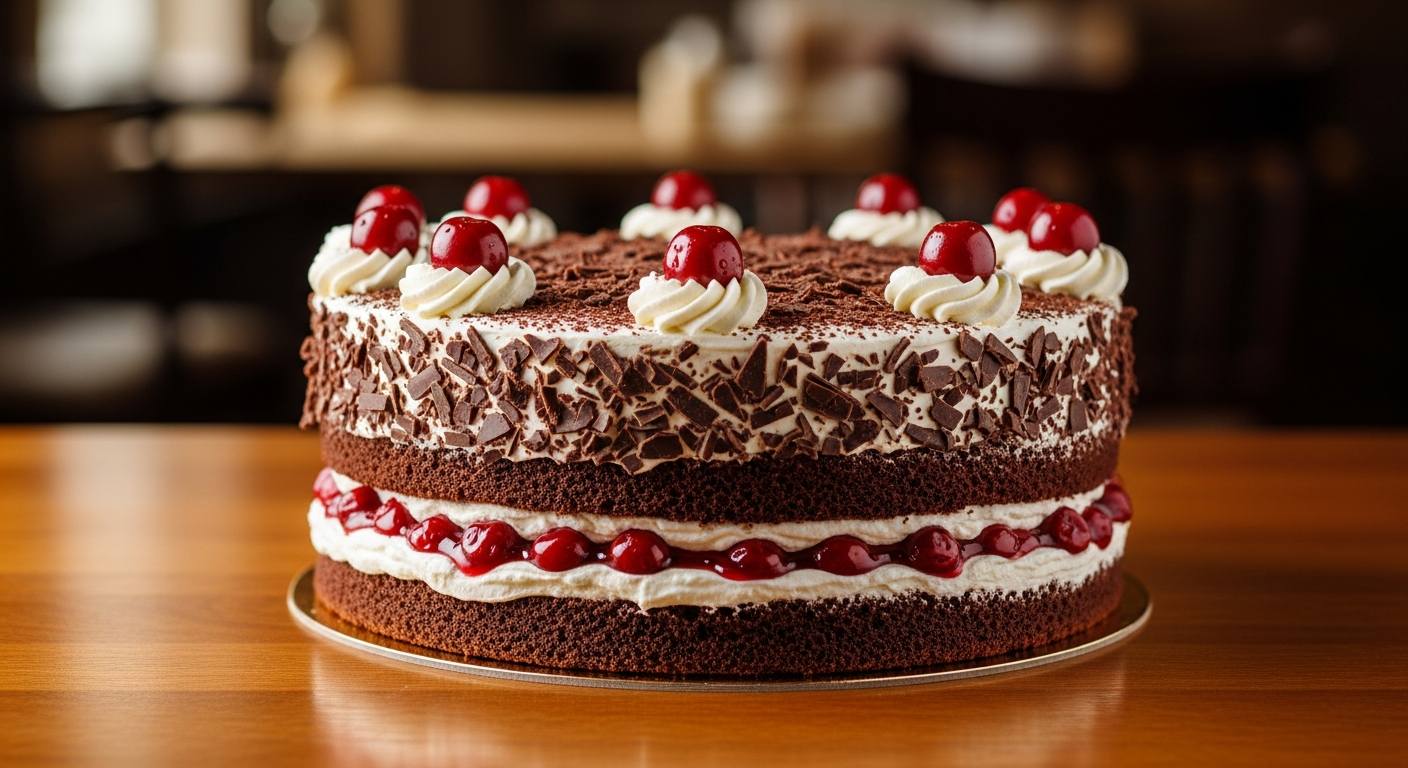
Despite its global variations (some skip the alcohol or use different cherries), the classic German Black Forest cake is still the benchmark. German bakers often insist on Kirschwasser in the cake, and the decoration of whipped cream, cherries, and chocolate shavings is a must.
Why the Layers Matter
The layered structure of the cake reflects its heritage. Each slice shows:
-
Dark chocolate sponge (the forest’s darkness),
-
Bright red cherries (the forest’s cherries or hat pom-poms),
-
Soft white cream (the forest’s snowy winter).
This tri-color combo isn’t just pretty – it connects the cake to its roots. Many Germans see it as a symbol of their baking tradition, a rich but not overly sweet dessert that can be both casual and festive. It’s often served at birthdays or weddings, much like how other cultures have special celebration cakes.
Even today, you can find festivals celebrating the cake. In the Black Forest town of Todtnauberg, a biannual “cake festival” was held (as recently as the 2010s), where people compete for the best Black Forest gateau. For locals, it’s “Freiburg’s most famous export,” as one tourism official put it.
Fun Facts and Theories
-
What’s in a Name? Besides cherries and costume colors, another theory says the name comes partly from cherry schnapps: Kirschwasser was a Black Forest specialty. Since Kirsch is in the name, it hints at that famous cherry liquor.
-
Not Just German: Some food historians think a cake like this could have been cooked up in Switzerland or Austria and then adopted by Germany. After all, Switzerland also makes Kirsch and cherries, and they often call it their national dessert. But today everyone agrees the Black Forest cake is a hallmark of German cuisine.
-
Video Games: In pop culture, the cake even pops up now and then – for instance, the popular video game Portal (2007) jokingly promised “cake” to players, referencing this iconic dessert.
No matter the origin story, one thing’s clear: people love this cake. It balances flavors — not too sweet, with a hint of boozy cherry — making it broadly appealing. Even if some modern recipes skip the alcohol, the traditional Schwarzwälder Kirschtorte is celebrated for being rich yet light, decadent but not cloying.
Today, every slice of Black Forest cake carries a piece of culinary history. It tells a tale of German forests, festive ingredients, creative bakers, and how a regional treat became a global favorite. The next time you enjoy it, you’re tasting not just chocolate and cherries, but a century of tradition.
Frequently Asked Questions
Q: Where did Black Forest cake come from?
A: It comes from the Black Forest region (Schwarzwald) in southwestern Germany. This area is famous for sour cherries and cherry brandy, which are key to the cake. The modern Black Forest cake developed there in the early 1900s.
Q: Who invented the Black Forest cake?
A: There’s no single inventor we know by name. Two early pastry chefs often credited are Josef Keller (around 1915) and Erwin Hildenbrand (1930s), but the cake likely evolved over time. Bakers in the Black Forest were already using chocolate, cherries, and cream in desserts, and these ideas came together to form today’s cake.
Q: Why is it called “Black Forest” cake?
A: The name refers to the region. The cake uses local ingredients like cherries and Kirsch (a cherry schnapps), and its colors — dark chocolate, white cream, red cherries — match traditional Black Forest (Schwarzwald) costumes and scenery. So it was named in honor of the Black Forest area.
Q: What does Schwarzwälder Kirschtorte mean?
A: In German, Schwarzwälder means “Black Forest” and Kirschtorte means “cherry cake” or “cherry tart.” So Schwarzwälder Kirschtorte literally translates to “Black Forest cherry cake.” It’s the original name for Black Forest cake.
Q: What are the main ingredients of Black Forest cake?
A: Traditionally, it’s made of chocolate sponge cake layers, whipped cream, sour cherries (often soaked in kirsch), and cherry brandy (Kirschwasser). It’s usually decorated with whipped cream, more cherries, and chocolate shavings on top. Kirsch gives it a signature flavor, but some modern versions skip the alcohol.
Q: When did Black Forest cake become popular?
A: It started gaining fame in the 1920s and 1930s in Germany. After World War II, it became internationally popular. By the 1960s, it was common in American and European bakeries. Today it’s considered a classic German dessert around the world.