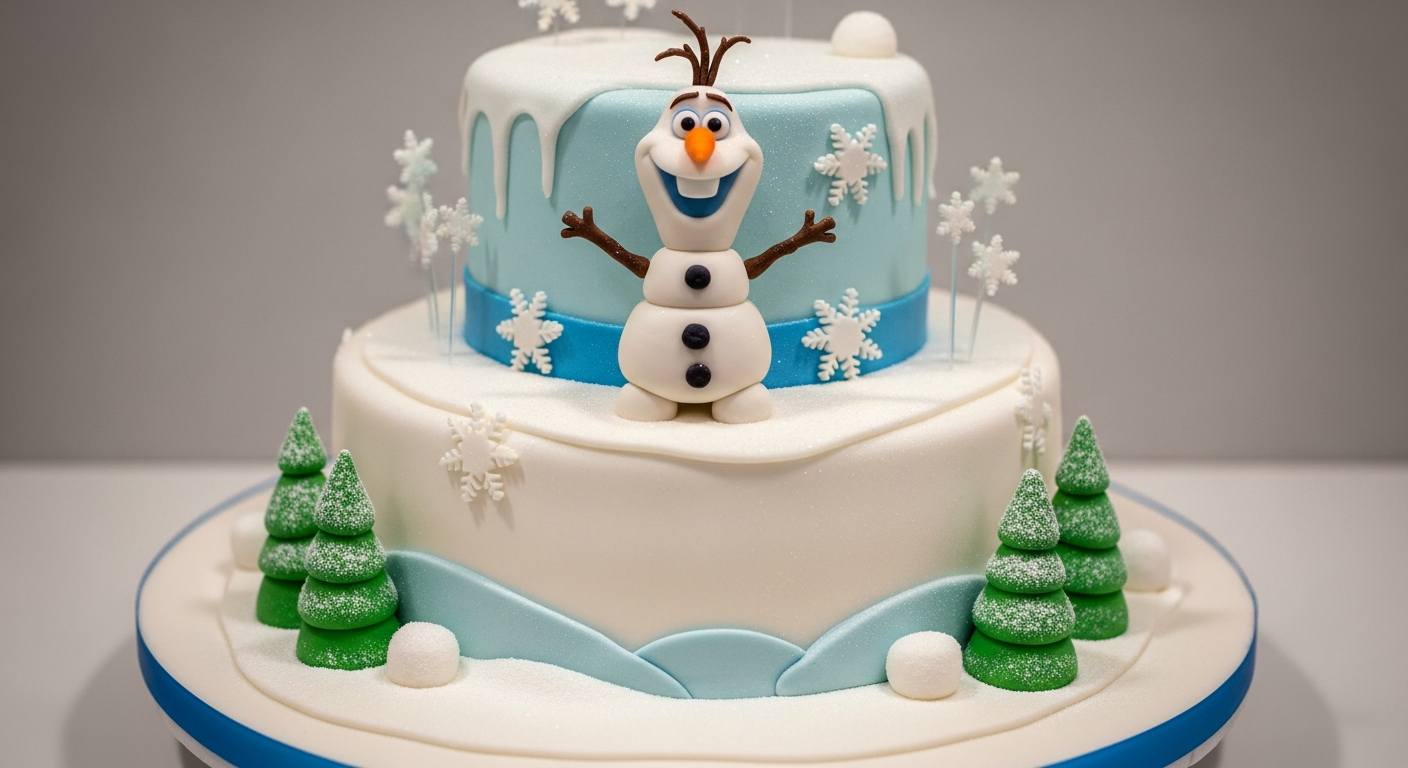
An Olaf Frozen cake is a fun Disney-themed dessert made to look like Olaf the snowman from Frozen. In other words, it’s a cake decorated or shaped to resemble Olaf’s three round snowballs, smiling face, carrot nose and twiggy arms. This cake is a big hit at Frozen-themed parties, and the good news is you can make one at home! Even if you’re not a pro baker, a little patience will pay off. For example, Barry Lewis (a popular home baker) says, “I’m pretty terrible at making cakes… if I can do this you definitely can!”. In this guide, we’ll show you two easy DIY approaches – a simple decorated cake and a sculpted cake – with step-by-step tips so you can build your own Olaf Frozen cake.
One way to make an Olaf cake is to simply decorate a round cake. In the example above, white icing is piped into Olaf’s snowman shape on a purple-frosted cake. This method uses plain buttercream or fondant to draw Olaf’s body and face on top of the cake, then adds candy features. For instance, the blogger Behind the Baker starts by applying a thin crumb coat of white icing, then finishes the cake with a purple buttercream background to make Olaf pop. You can then pipe Olaf’s three white snowballs (body, midsection, head) with icing and add details like a smile, eyes and buttons. Ann Reardon’s recipe for an Olaf cake suggests giving him “Italian meringue frosting for his snow, chocolate arms, Oreo-encrusted buttons and [a] Starburst nose” to capture the Frozen look. (You can substitute any orange candy or fondant for the nose and black icing or candies for the buttons.) In short, decorating a flat cake is a great “first Olaf cake” project: cover the cake in white icing or fondant for Olaf’s body, pipe on the facial features, and use colored frosting around it for a wintery sky.
What You’ll Need to Get Started
Before baking, gather your ingredients and tools:
-
Cakes: You need three round cake layers (about 8-inch or 20cm each). Two large circles become Olaf’s bottom and mid-body, and one smaller layer is for his head. These can be homemade sponge cakes (vanilla, chocolate, or your favorite) or store-bought cakes if you’re in a hurry. (As Ann Reardon notes, a store-bought sponge “is a fine alternative” if time is short.) Make sure the cakes are fully cooled before decorating.
-
Frosting/Icing: White buttercream or whipped frosting to cover Olaf’s body. You’ll also want a bit of colored icing or fondant: orange (for the nose), black (for eyes and buttons), and any background color like blue or purple. (One tutorial frosted the cake purple for an icy background.) If you like, a candy snowflake or two can add flair.
-
Decorations: Edible decorations for features. For Olaf’s carrot nose, use orange fondant, fondant dyed orange, or an orange candy (gumdrop or Starburst) rolled into a cone. For the eyes and buttons, roll tiny white and black fondant balls or use small candies (Ann used mini Oreos for buttons). Black icing can draw the eyebrows and mouth. For arms and hair, melted chocolate piped into twig shapes works great (or use pretzels/licorice sticks).
-
Tools: A serrated knife for carving, offset spatula, mixing bowls, rolling pin (if using fondant), piping bags/tips (for eyes or snowflakes), and a cake board to assemble Olaf on. It also helps to have a printed Olaf template (just an outline of Olaf’s shape) to guide you as you carve.
Step 1: Bake and Cool the Cakes
Preheat your oven and bake your cakes first. You’ll want three round cakes, roughly the same flavor (vanilla or chocolate works). If you only have two pans, bake two, then use the second one’s scraps or a small cake pan (or cut a third smaller circle from one of them) for Olaf’s head. Once baked, let all cakes cool completely – cool cakes are much easier to carve without crumbling.
Tip: Use a very light, fluffy recipe for Olaf’s head so it won’t collapse. As one baker warns, a heavy cake may need internal supports (like wooden dowels) between layers; otherwise “Olaf will melt like a snowman in Summer”. In practice, a sponge cake or adding cake boards and dowels is a safe bet.
Once cooled, level each cake (cut off any rounded top) so the surfaces are flat. Wrap and store one layer in the fridge while you work on the others, so they stay firm.
Step 2: Carve and Assemble Olaf’s Body
Now form Olaf’s snowman shape from your cake rounds. Place a large cake circle on the board for the bottom. Next, use your Olaf template (taped on parchment or traced) to draw or lightly indent the outline of Olaf on the next cake. Cut out Olaf’s middle section from one of the cakes. For the head, cut a smaller circle (or use the third cake layer) and shape it like Olaf’s head. You should end up with three pieces: bottom, middle, and top (head).
Once cut, stack the pieces: spread a thin layer of frosting, jam, or Nutella between each layer to act as edible “glue.” Barry Lewis suggests brushing the cake edges with a sticky topping (he used Nutella) before pressing them together. This helps the pieces stay put. Arrange them on your cake board so Olaf stands upright. If the bottom feels wobbly, put a dab of frosting or Nutella under it on the board – Barry even sticks Nutella under the cake to keep it from sliding. If you made Olaf very tall, insert a couple of wooden dowels through the layers for extra support (especially between the head and upper body).

Step 3: Crumb Coat and Frost the Cake
With Olaf assembled, apply a thin crumb coat of white frosting: spread a light layer over all exposed cake surfaces to seal in crumbs. This doesn’t have to look perfect – it just traps loose crumbs so the final icing is clean. Chill the cake for a few minutes to set that layer.
Next, cover Olaf in the final layer of white icing (or roll out white fondant and drape it over each section). Smooth the frosting carefully around the curves. Barry’s tip for fondant: “roll out your icing thinly and drape over the pieces, cutting away any excess and tucking in”. If the fondant pulls, moisten lightly with water to help it stick. Take care to smooth the fondant or frosting so Olaf’s body looks round and seamless. Make sure to cover the base of each “snowball” and the seams between layers so nothing of the cake shows.
At this point, Olaf already looks like a white snowman! (Some decorators even use a small round tip to pipe additional snow around the base.) You could also chill the cake again so it’s nice and firm before doing detail work.
Step 4: Decorate Olaf’s Face and Details
Now let’s give Olaf his personality:
-
Eyes & mouth: Roll out tiny balls of white fondant for Olaf’s eyes, and smaller black fondant for pupils. Press them gently onto the fondant (or pipe them in icing). For the mouth, draw a curved smile with black icing or shape black fondant. Barry suggests cutting a little white rectangle for Olaf’s single big tooth and placing it in the open mouth.
-
Buttons: Form three round balls of black fondant or icing and stick them vertically down Olaf’s front. (You can use round candies or Oreos as well – one baker used mini Oreo cookies for buttons.)
-
Nose: Shape a carrot nose from orange fondant or an orange candy. Barry and others roll orange fondant into a cone; Ann Reardon actually used orange Starburst candy in her tutorial. Attach it in the middle of Olaf’s face with a dab of water or frosting.
-
Arms and hair: Melt some dark chocolate and pipe thin twig-like branches onto wax paper for Olaf’s arms and little hair sprigs. Let them set in the fridge until hard. (If you prefer, you can use brown licorice sticks or pretzels.) Gently stick these into the sides of Olaf’s body and top of his head – the fondant will hold them. Barry piped both arms and Olaf’s hair/eyebrows from chocolate.
-
Snow details (optional): For a final Frozen touch, you can make little snowballs or snowflakes around Olaf. Roll leftover white icing into tiny balls and place them around the base or use a star tip to pipe snow. Barry even used extra frosting to create piled snow. Another fun idea from a cake blogger: blend pale blue buttercream in an ombre swirl on the cake board or edges to look “icy” – she “started with the blue section first at the bottom, then combined the middle with white and blue” for a cool effect. You could also sprinkle edible glitter or sugar snowflakes for more sparkle.
With the details in place, you now have a completed Olaf cake. Take a moment to admire Olaf’s big smile and carrot nose – you built him yourself!
Tips & Final Thoughts
-
Work patiently: If you get stuck, remember that even ordinary home bakers can do this. Barry Lewis says making this cake taught him patience, and he encourages beginners: “take your time and this will work out perfectly”.
-
Practice piping: If you’re new to icing, practice making Olaf’s eyes and smile on parchment first. Once confident, transfer them to the cake.
-
Make ahead: You can bake the cakes a day early and freeze or refrigerate them. Assemble and decorate the cake a few hours before the party so Olaf looks fresh. If refrigerated, let Olaf sit at room temperature 15–30 minutes before serving to soften the frosting for easy cutting.
-
Stay creative: You can adapt Olaf’s size and details however you like. Some bakers even try different flavors for each “snowball.” As long as the proportions feel right, Olaf will come to life.
Building an Olaf Frozen cake is a fun way to delight any Frozen fan. Follow these steps, add your own creative touches, and soon you’ll be hearing, “Do you want to build a snowman?” from excited party guests. Happy baking and enjoy your Olaf masterpiece!