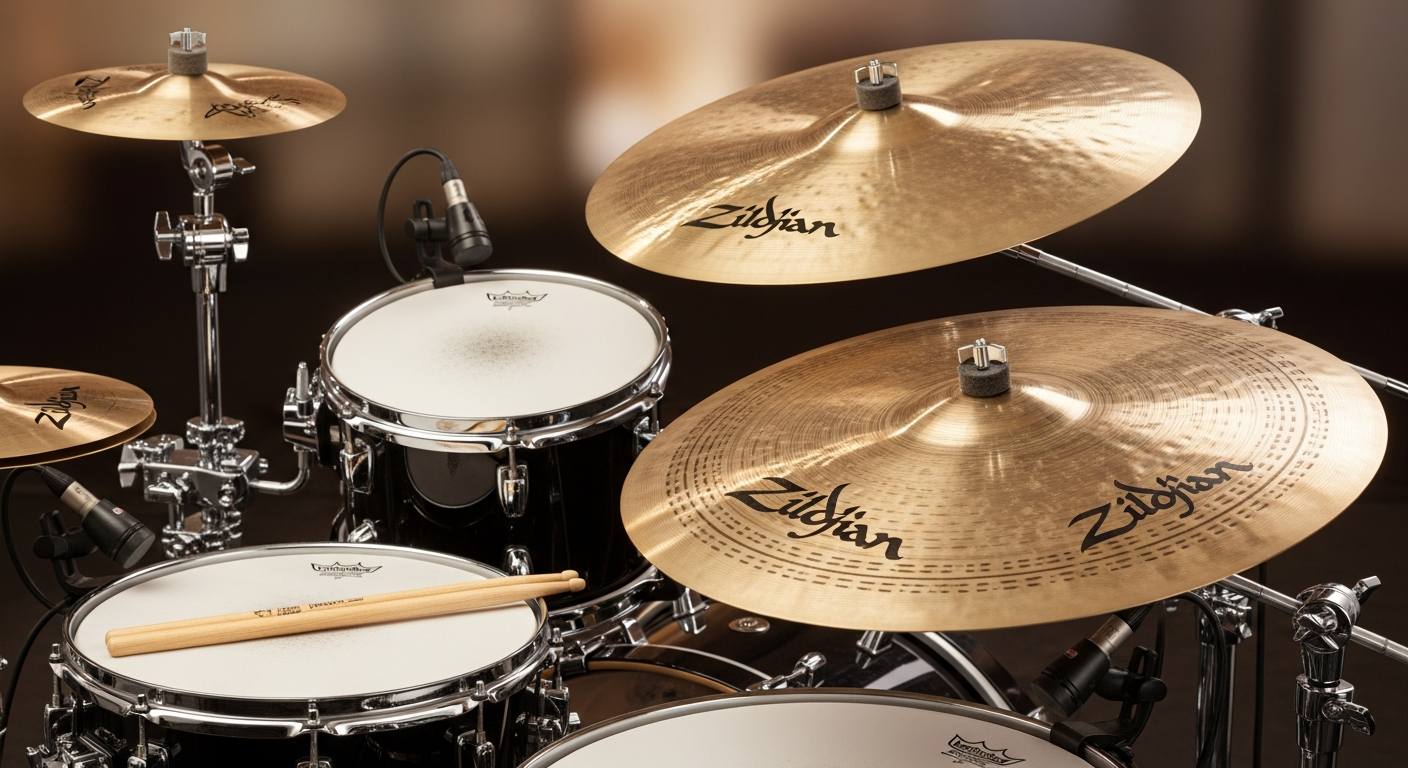
In a drum set, the phrase “pair of cymbals” almost always refers to the hi-hat. The hi-hat is exactly that – two matching cymbals mounted face-to-face on a stand, with a foot pedal that opens or closes them. When the drummer presses the pedal, the top cymbal moves down to meet the bottom one; releasing the pedal lets them part. This pedal mechanism lets the drummer switch between a tight “chick” sound (pedal pressed, cymbals closed) and a loose, ringing “wash” (pedal released, cymbals open). Because of this flexibility, the hi-hat is a core timekeeping instrument in many styles of music – from rock and pop to jazz and blues. In short, on most drum kits the two cymbals next to the snare drum are not two separate instruments at all but the hi-hat.
Anatomy of the Hi-Hat
Each hi-hat cymbal is typically 13–15 inches (33–38 cm) in diameter, making them smaller than a standard crash or ride cymbal. They come as a matched pair (for example, a “14-inch top” and “14-inch bottom” set), and they’re usually made of a durable bronze alloy. On the hi-hat stand, the bottom cymbal sits fixed on the stand’s base, while the top cymbal is attached to a vertical rod that the foot pedal controls. Pressing the pedal pulls the top cymbal down, and a spring inside the stand pushes it back up when you lift your foot. Drummers can adjust the spring tension: a very tight spring makes the hats close quickly with a short, crisp sound, while a looser setting lets the cymbals glide and produce a longer “wash.” Switching between these positions produces very different sounds. (For instance, a tightly closed hi-hat gives a quick “tick,” whereas even a slight opening yields a splashier tone.) This whole pedal-and-spring mechanism is unique to the hi-hat – crash and ride cymbals on the kit don’t move or have pedals.
Playing the Hi-Hat: Open, Closed, and More
Drummers use several techniques on the hi-hat to create different rhythms. Common approaches include:
-
Closed Hi-Hat: Press the pedal to keep the cymbals tightly together and strike them with a stick. This produces a short, sharp “tick” or “chick” sound. Closed hi-hats are great for a steady, crisp beat.
-
Open Hi-Hat: Lift your foot so the cymbals are apart when you hit them. The sound is looser and more sustained – almost like a splash of cymbal. Open hi-hats add energy and space; for example, an open hi-hat on the “&” of the beat is a classic rock accent.
-
Half-Open Hi-Hat: Keep the pedal partway down, so the cymbals barely touch. Striking in this position gives a slushy, buzzing sound that sits between open and closed. Drummers use this for a groovy, laid-back feel.
-
Pedal “Chick” (Foot Hi-Hat): Without using the sticks, quickly press and release the pedal. The cymbals collide with a clean “chick” or “click” sound. This quiet, subtle sound (sometimes called a foot “chick”) is useful on off-beats or in soft passages. In fact, a gentle foot-press is often used instead of a stick hit on beats 2 and 4 in swing-style jazz. It creates a very soft note – as one source notes, a light foot-chick is suitable for soft accompaniment, while a hard open hit is used for loud sections.
-
Choke (Quick Close): Strike the hi-hat (often while it’s open) and immediately step on the pedal to clamp the cymbals shut. This “chokes” the sound abruptly, creating a very short, accented effect. Drummers use this for dramatic stabs or to cut off an open sound quickly (for example, closing the hats right after an open crash to stop the ring).
By combining these techniques, the hi-hat becomes extremely versatile. You can play even, steady pulses (like eighth notes in a rock beat) or vary up-and-down strokes for a jazz swing feel. The wide range – from nearly silent foot-clicks to loud open crashes – lets the drummer add texture and dynamics. As noted earlier, a light foot-pressed hi-hat yields a whisper-quiet “chick,” whereas a forceful strike on an open hi-hat produces a loud crash (even fitting for heavy metal music). In practice, even beginner drumming lessons start with a basic hi-hat pattern, since it locks the kit’s groove together.
Why Hi-Hats Matter in Music
The hi-hat is often called the heartbeat or glue of many drum patterns. It works hand-in-hand with the bass drum and snare to lock in the rhythm. For example, a very common drum pattern in rock and pop is:
-
Count: 1 & 2 & 3 & 4 &
-
Drums: Bass on 1 and 3, Snare on 2 and 4, Hi-Hat on every “&”
In this pattern, you mostly hear a steady “tick-tick-tick-tick” on the hi-hat between the heavy bass and snare hits. Even though the hi-hat is quieter than the bass and snare, its constant pulse gives the music momentum and clarity. In jazz or swing styles, the drummer might instead play only on beats 2 and 4 (often using just the foot “chick” on those beats), which gives a light, swinging feel to the rhythm.
Beyond basic pulses, hi-hats let drummers shape the song’s energy. Opening the hi-hat slightly (even for a single stroke) brightens the sound and can build excitement – you’ll often hear drummers open the hats as they transition from a quiet verse into a big chorus. Returning to closed hi-hats then pulls the groove back into a tighter, more controlled feel. Drummers can also gently ride the foot on and off the pedal to create subtle “sizzle” effects (known as a “hi-hat swell”). Overall, by varying how the hi-hat is played – open vs. closed, loud vs. quiet, with sticks or foot – the drummer controls the mood. In quieter passages a soft, closed hi-hat keeps time discreetly, while in louder sections an open hi-hat or quick heel-down hit provides crisp accents. In fact, as one source explains, by controlling these techniques a hi-hat can go from a soft, almost hidden tick to a loud crash in heavy music.
Other “Pairs of Cymbals”?
It’s worth noting that outside the drum kit world, “a pair of cymbals” can mean something else. In orchestral or marching percussion, a pair of handheld crash cymbals is common – the musician holds one cymbal in each hand and crashes them together. However, on a standard drum kit, those cymbals are not part of the setup. Drum kits use single crash and ride cymbals, which are not referred to as a pair. So when drummers or drum shops talk about a “pair of cymbals” in a drum kit context, they always mean the hi-hat (You will rarely hear a drummer say “pair of crash cymbals” even if there are two crashes; they just call them “two crash cymbals.”) In short, for a normal drum set the only true “pair” of cymbals is the hi-hat.
Summary
In summary, on a drum set the “pair of cymbals” is the hi-hat – two cymbals on a stand with a foot pedal. This pair is fundamental because it lets the drummer play closed, open, and pedal-only notes for a huge range of sounds. From a tight foot-click to a wide-open splash, the hi-hat controls the rhythm’s feel. It’s one of the first things drummers learn about, since it essentially keeps the time and adds excitement to the groove. Now when you look at a drum kit, you’ll know that this pair of cymbals is not just decoration or an extra crash – it’s the versatile hi-hat.